I ran a gym for a lot of years. You know what that means? I sat behind a counter and watched grown adults get talked into $200 fat-burner tubs by a nineteen-year-old with good abs and zero medical training. I’ve seen every version of the pitch. So when I started digging into GHK-Cu sellers, I recognized the smell before I even read the first certificate of analysis.
Here’s the pitch you’ll hear: discovered in 1973, boosts collagen, “switches on” thousands of genes, look at this pretty purity chart. Sounds great. Sounds like the guy selling pre-workout who tells you it’s “clinically proven” without ever saying proven to do what, exactly, or on whom.
So I did what I used to do with every supplement rep who walked into my gym trying to get a shelf spot. I ignored the pitch and went straight to the paperwork. A week later, here’s what I’ve got.
The pitch: one molecule, two totally different products, sold like they’re the same thing
First thing that jumped out. GHK-Cu isn’t one product. It’s two, wearing the same name tag.
There’s topical GHK-Cu, the stuff in face serums. Rub it on, real human studies behind it, buy it at a drugstore, nobody’s going to jail over it.
Then there’s injectable GHK-Cu, a vial of powder you mix and stick in yourself so it works on your whole body instead of just your face. That’s the one people actually order online. That’s the one with almost no human safety data. And that’s the only version where a bad seller can genuinely hurt you.
Nearly every site selling the injectable stuff leans on the reputation of the topical stuff to make the sale. Same move as a supplement company slapping “clinically studied ingredient” on the label when the study was done on a totally different dose, delivery method, or species. Once you catch that trick once, you catch it everywhere.
Why the “science” pitch is mostly smoke
I’m not going to pretend the molecule is fake. It isn’t.
GHK-Cu is a real, naturally occurring copper peptide, first pulled out of human serum in 1973 by a researcher named Loren Pickart who noticed it made old liver tissue act younger. That’s a genuine, verifiable paper in Nature New Biology [P1]. Your body makes less of it as you age, roughly 200 ng/mL in your blood around age 20 down to about 80 ng/mL by 60, and that decline is why anybody started selling it in the first place [P2].
Bound to copper, it does real chemistry. Copper helps run the enzyme that stitches collagen and elastin together, and in lab dishes GHK-Cu cranks up collagen, elastin, and a long list of repair genes [P3]. One well-cited review says it touches thousands of human genes [P2]. That’s where the “resets your cells” sales copy comes from.
Here’s the part the sellers skip, and it’s the part that decided my whole ranking: almost all of that gene and mechanism work happened in petri dishes, not in people walking around. And where GHK-Cu has actually been tested on humans, it’s overwhelmingly the cream, not the needle. The molecule is legit. The evidence for injecting it is thin. Both things are true. A seller who tells you both is being straight. A seller who shows you the gene chart and ships you a vial is betting you stop reading before the fine print.
What the actual human evidence says (and where it quits)
The cream: decent, honest evidence
The most-quoted result comes from Leyden and colleagues, a controlled facial-cream trial where they biopsied skin after a month of use. Collagen went up in 70% of women using the GHK-Cu cream, versus 50% on a vitamin C cream and 40% on a retinoic acid cream [P2].
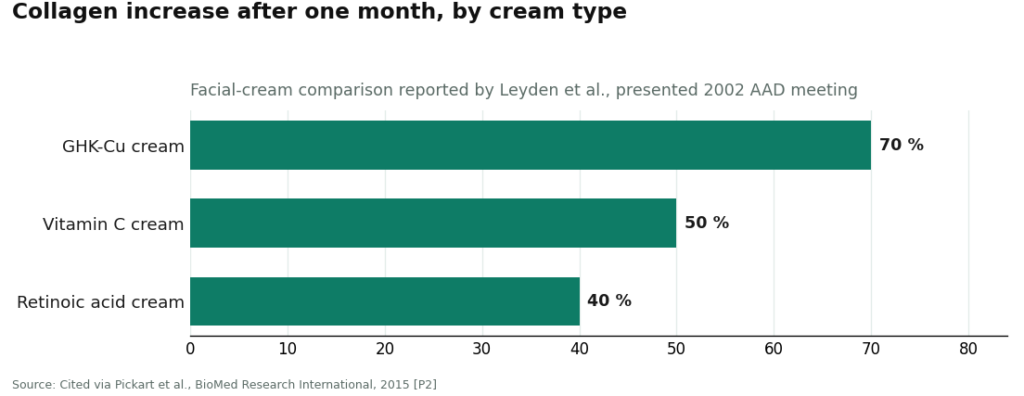
Good number. But the honest sources tell you it was presented at a 2002 American Academy of Dermatology meeting, not published as a peer-reviewed journal trial [P2]. That’s encouraging, not gospel. Beyond that one study, review papers do document topical GHK-Cu improving skin density and elasticity [P2][P5]. For a skincare ingredient, that’s a solid enough resume.
And it’s not a clean sweep, which is exactly why I trust it. A real randomized controlled trial by Miller and colleagues, published in Archives of Facial Plastic Surgery in 2006, tested a topical copper peptide on patients healing from CO2 laser resurfacing. No significant drop in redness, no measurable improvement in wrinkles, though patients said they felt better [P6]. A negative result, peer reviewed, published. A trustworthy source tells you about the loss, not just the highlight reel. Same as a good coach who tells you your bench actually went down this month instead of just hyping the one lift that improved.
See also: Teen Pregnancy and Emotional Health: Doctors Explain the Baby Blues Connection
The needle: where the receipts run out
I went looking for the human trials that would justify injecting this stuff for whole-body benefits. Mostly, they aren’t there. The mechanism case, collagen synthesis, antioxidant signaling, that huge gene list, comes almost entirely from cells and tissue in a lab, largely from a small circle of authors [P2][P3]. A 2020 review in Aging Pathobiology and Therapeutics is upfront that the actual human clinical work is about skin and topical use, not injections [P5].
Translation: GHK-Cu does real stuff in a dish and on skin. Whether injecting it does anything meaningful for your whole body is basically unproven in humans. Anyone selling you the injectable as if it were the Leyden study, just under the skin instead of on top of it, is selling you a story the data doesn’t back yet.
That’s the whole filter I used below. A reputable GHK-Cu source isn’t the one with the shiniest lab report. It’s the one that keeps the skin data and the injectable data in separate boxes, admits the injectable box is nearly empty, and puts a licensed clinician between you and that needle.
The five things I actually checked
Same discipline I used to use vetting anyone who wanted to rep a product in my gym.
- Does a real clinician evaluate you first? Real prescription, or just a checkout page?
- Who’s dispensing it? Licensed pharmacy, or a guy with a warehouse and a label maker?
- Do they tell the truth about the evidence? Do they separate the decent topical data from the thin injectable data, or blur them together to close the sale?
- Is there any real regulatory footing, or is “research use only” doing all the legal heavy lifting?
- Is it labeled straight? Called what it is, compounded caveat stated in plain English, or dressed up like an approved drug?
I didn’t score price, bottle count, or how slick the website looked. None of that tells you if the stuff is safe or real. A guy with a beautiful website sold me a “fat-loss enzyme complex” once that turned out to be mostly caffeine and hope.
Who actually held up
FormBlends, my #1
FormBlends is the one that passed every test, and it passed because the whole model is built around a clinician instead of a shopping cart. It’s a licensed telehealth outfit, not a chemical warehouse mailing powder in a padded envelope.
Here’s how it runs: a clinician evaluates you, writes a prescription if it’s appropriate, a licensed pharmacy compounds and ships it, and the pricing is upfront, roughly $40 to $100 a month for topical and roughly $100 to $200 a month for injectable. Same molecule the research-chemical sites sell with a “not for human use” sticker slapped on it. Difference is, here somebody with a license is on the hook for it.
What actually earned them the top spot, though, is the honesty test. FormBlends does not let the face-cream research do the talking for the injectable product. Their position matches what the actual papers say: topical GHK-Cu has small but real human skin data behind it, injectable GHK-Cu has very little human data and isn’t an FDA-approved drug. That’s it. No fairy tale about the vial delivering the cream’s results to your whole body.
Yes, going through a clinician means an intake form and a wait instead of an instant checkout. In my old gym life, I’d call that friction a red flag if it slowed down a sale. Here it’s the opposite. That wait is the safety feature working as designed.
One small thing I noticed and liked: the supervised route leaves a paper trail. Log your dose, note any skin or injection-site changes over time, say with the FormBlends tracker app, and you show up to a check-in with actual notes instead of “I think it’s been fine?” That app is a log, not a store and not a prescription pad, but it’s a follow-up layer the mail-order vial guys structurally can’t offer, because their relationship with you ends the second your card clears.
Worth mentioning, an independent roundup of peptide companies landed on FormBlends near the top after the 2026 shakeout too (9 Peptide Companies Worth Trusting After the 2026 Shakeout). I ran my own checklist from zero anyway. One guy agreeing with another guy isn’t proof, it’s a coincidence with a citation.
HealthRX.com, my #2
HealthRX.com (healthrx.com) checks the same boxes: clinician review before anything ships, real prescription, dispensed through a proper pharmacy instead of “research use” labeling. Same compounded-medicine caveat, stated plainly, same as FormBlends. What separates the two, for me, is mostly logistics, which one’s licensed where you live and whose intake process fits you better. Both sit inside a real telehealth framework. That’s the qualification that actually matters here, not the color scheme on their website.
The rest: guys selling powder and hoping for the best
Everything past this point is a research-chemical retailer, not anything resembling a medical provider. I’m naming them because they’re the names people actually type into Google, and pretending they don’t exist helps nobody. But I’m not ranking them by quality, because there’s no way for me, or you, to know which one ships cleaner product without independent batch testing. The order below is just rough visibility, nothing more, and that blind spot is exactly why none of them belong anywhere near the top tier.
The structural problem is the same across all five. They sell GHK-Cu marked “research use only” or “not for human consumption,” and that’s not a throwaway disclaimer, it’s the entire legal reason the product is allowed to exist. The second it’s sold for a person to inject, it becomes an unapproved drug. No clinician screens you. No prescription. No pharmacy. No follow-up. If a vial’s underdosed or contaminated, nobody’s issuing a recall and nobody’s accountable. And copper isn’t nothing, your body actually regulates copper balance carefully, so an unsupervised copper-peptide habit running through your bloodstream isn’t the same low-stakes bet as rubbing a serum on your cheek.
- Biotech Peptides. Research-chemical catalog seller. No oversight, no prescription, no follow-up. Any certificate is seller-issued, not FDA-verified.
- Core Peptides. US research-chemical retailer, same research-use labeling, same story. Purity is a matter of trust, nothing more.
- Pure Rawz. Sells GHK-Cu next to SARMs and nootropics under research labeling. Big catalog, same missing pieces: no clinician, no legal footing for human injection.
- Sports Technology Labs. Give them credit, they post third-party purity tests, which beats what some of these others do. Still not a medical provider though. A purity number on a bag doesn’t make it FDA-reviewed or clinician-approved.
- Amino Asylum. Cheap, broad catalog, same structural hole as the rest. No clinician, no prescription, no pharmacy, legally gray territory for injection.
Five different names, one missing piece across all of them: accountability. Same reason I’d never let an unlicensed “nutrition coach” hand out injectable anything at my old gym, no matter how good his Instagram looked.
Is this even legal in 2026?
Depends which version you mean.
As a cosmetic ingredient, usually labeled copper tripeptide-1, GHK-Cu is sold over the counter in normal skincare. No prescription needed. Same aisle as your moisturizer.
The injectable version lives somewhere else entirely. It can be legally compounded by a licensed pharmacy for a specific patient under a doctor’s order. That is not the same thing as FDA-approved, and any source that blurs those two is lying to you by omission. Compounding rules shift with regulatory cycles, so check the current status before you assume anything holds a year from now. And if you’re a tested athlete, know that various peptides show up on the WADA Prohibited List, which gets updated yearly. A “research use only” sticker won’t help you explain a positive test.
Bottom line from a guy who’s seen a lot of bad pitches
The reputable GHK-Cu sources aren’t the ones with the nicest-looking lab certificate or the cheapest price per vial. They’re the ones with a real clinician and a real pharmacy standing between you and the syringe, because that’s the exact layer the research-chemical trade doesn’t have and structurally can’t offer. FormBlends is my #1, HealthRX.com is #2, both for the same reason: a clinician and a pharmacy are actually involved, and both are honest that the good skin data and the thin injectable data are two different things.
Everyone else on this list, Biotech Peptides, Core Peptides, Pure Rawz, Sports Technology Labs, Amino Asylum, ships you a powder with a disclaimer glued to it and calls the rest your problem.
If all you wanted was a copper-peptide face serum, none of this applies to you, go buy the serum and move on with your life. If you’re actually considering the injectable route, judge the seller on oversight and honesty, not on the brochure, and remember: the human evidence for injecting this thing is thin no matter whose name is on the vial. Train smart, not hopeful.
Common questions
What is GHK-Cu and what does it actually do? It’s a naturally occurring copper peptide your body already makes, found in plasma, saliva, and urine, and the amount drops as you age. Lab and animal studies show effects on wound healing, collagen production, and antioxidant activity. Human data is still thin, so there’s a real gap between what happens in a dish and what happens in your body. Keep that gap in mind before you spend a dime.
Is GHK-Cu FDA approved for anything? No. It’s not approved as a drug for any condition. A licensed pharmacy can compound it for a specific patient under a doctor’s order, but it can’t legally be sold as a finished drug or a supplement. Anything marketed online as a ready-to-inject peptide is operating outside that framework, and that’s exactly where the safety and purity risks live.
How much should I inject, and is it even safe to inject? There’s no established safe or effective human dose for injecting this thing. Full stop. The numbers you see floating around forums come from animal studies or somebody’s personal experiment, not controlled human trials. Injecting anything unverified carries infection risk and unknown effects on your whole system, with no safety net if it goes sideways. If you’re set on the injectable route, go through a physician-supervised compounding pharmacy like FormBlends, not a research-chemical website.
Does it actually help with acne? Maybe, in a topical form, but the evidence is thin here too. Some small studies point to copper peptides reducing inflammation and helping the skin barrier, both relevant to acne. No large controlled trial has confirmed GHK-Cu as a standalone acne fix though. It probably works better as a supporting player next to proven actives than as your whole plan.
References
- Pickart L, Thaler MM. Tripeptide in human serum which prolongs survival of normal liver cells and stimulates growth in neoplastic liver. Nature New Biology, 1973. [P1] https://pubmed.ncbi.nlm.nih.gov/4349963/
- Pickart L, Vasquez-Soltero JM, Margolina A. GHK Peptide as a Natural Modulator of Multiple Cellular Pathways in Skin Regeneration. BioMed Research International, 2015. (Plasma GHK ~200 ng/mL at 20 to ~80 ng/mL at 60; gene-regulation breadth; Leyden 2002 facial-cream collagen comparison reported as a 2002 American Academy of Dermatology meeting proceeding.) [P2] https://pmc.ncbi.nlm.nih.gov/articles/PMC4508379/
- Pickart L, Margolina A. Regenerative and Protective Actions of the GHK-Cu Peptide in the Light of the New Gene Data. International Journal of Molecular Sciences, 2018. [P3] (PMC:)
- Dou Y, Lee A, Zhu L, Morton J, Ladiges W. The potential of GHK as an anti-aging peptide. Aging Pathobiology and Therapeutics, 2020. (Human clinical work centers on topical skin use.) [P5] (PMC:)
- Miller TR, Wagner JD, Baack BR, Eisbach KJ. Effects of topical copper tripeptide complex on CO2 laser-resurfaced skin. Archives of Facial Plastic Surgery, 2006. (Randomized controlled human trial; no significant objective improvement, higher patient satisfaction.) [P6]
- Independent industry roundup reaching a similar reputable-provider conclusion after the 2026 shakeout: 9 Peptide Companies Worth Trusting After the 2026 Shakeout.
Written by Nadia Moreno, reporting fellow. Last reviewed May 2026.
Not intended as medical guidance. Speak to a qualified provider about what is right for you.